How to read a flight itinerary:What are the essential components of a flight itinerary that I need to check?
Q: What are the essential components of a flight itinerary that I need to check?
A: A flight itinerary typically includes passenger name, flight number, departure and arrival airports with their codes, dates and times, terminal and gate information, and booking reference. According to the International Air Transport Association (IATA) Passenger Services Conference Resolutions Manual, these elements are standardized to ensure clarity. Always verify that the passenger name matches your travel document exactly, as even minor discrepancies can cause issues. The IATA also recommends checking the airport codes carefully, as some cities have multiple airports. Additionally, confirm the departure time is in the local time zone of the departure airport. This helps avoid missed flights due to time zone confusion.
Q: How can I interpret layover times in a flight itinerary?
A: Layover times indicate the duration between your arrival at a connecting airport and your departure on the next flight. The U.S. Department of Transportation (DOT) advises that for domestic flights, a minimum connection time of 30-60 minutes is often recommended, while international connections may require at least 1-2 hours, depending on the airport. However, these are not guaranteed, and airlines set their own minimum connecting times. When reading your itinerary, ensure the layover is sufficient for you to deplane, navigate the airport, and go through any required security or customs checks. If the layover seems short, contact the airline to confirm feasibility.
Q: What do the different airport codes in a flight itinerary mean?
A: Airport codes in a flight itinerary are three-letter IATA codes that uniquely identify each airport. For example, JFK stands for John F. Kennedy International Airport in New York, and LHR for London Heathrow. The International Air Transport Association (IATA) assigns these codes, which are used globally in ticketing and schedules. It's crucial to note that some cities have multiple airports with different codes; for instance, London has LHR, LGW, and STN. Therefore, when reading your itinerary, double-check the codes to ensure you're departing from or arriving at the correct airport. Mistaking the airport can lead to significant travel disruptions. Always verify the codes on an official IATA source if unsure.
Q: How should I read the date and time formats on a flight itinerary?
A: Flight itineraries typically display dates and times in the local time zone of the respective airport. The International Air Transport Association (IATA) recommends using the 24-hour clock format to avoid ambiguity between AM and PM. For example, 14:30 means 2:30 PM local time. When crossing time zones, the itinerary will show the local departure time at the origin and local arrival time at the destination. It's essential to adjust your watch accordingly. The IATA also suggests that travelers pay attention to the date change, especially for overnight flights; for instance, a flight departing on Monday may arrive on Tuesday. Always confirm the time zone to avoid missing your flight.
Q: What does the booking reference or PNR mean in a flight itinerary?
A: The booking reference, also known as Passenger Name Record (PNR), is a unique alphanumeric code (usually six characters) that identifies your reservation in the airline's computer system. According to the International Air Transport Association (IATA) PNR data standards, this code is used to retrieve your itinerary, manage bookings, and check in. When reading your flight itinerary, this reference is crucial for online check-in, contacting the airline, or making changes. It is typically found at the top of the itinerary. Keep this code confidential to prevent unauthorized access to your booking. If you have multiple flights on different airlines, you may have separate PNRs for each segment.
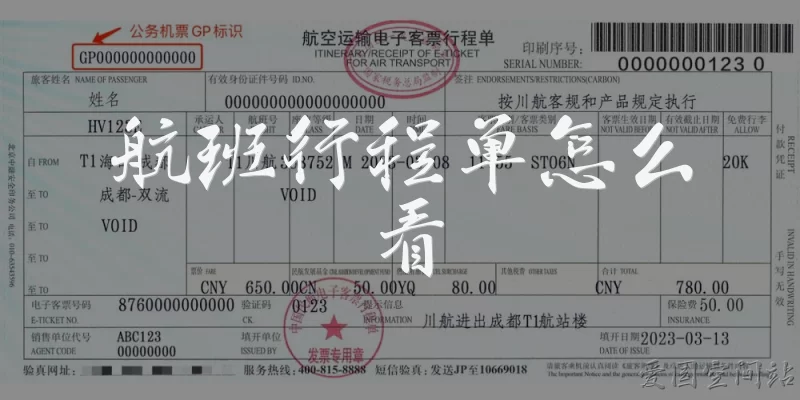
Dialogue about
Common scenarios of "How to read a flight itinerary"
【Traveler】 Hi, I just received my flight itinerary by email. I'm a bit confused about some parts. Can you help me understand it?
【Agent】 Of course! I'd be happy to help. What specific parts are confusing you?
【Traveler】 Well, at the top it says 'Flight Itinerary' and then there's a bunch of numbers and codes. What does 'Flight Number' mean?
【Agent】 The flight number is a unique code assigned to your specific flight. It usually consists of an airline code (two letters) followed by a number. For example, 'AA123' means American Airlines flight 123.
【Traveler】 Okay, I see 'UA456' on mine. So that's United Airlines flight 456?
【Agent】 Exactly! That helps you identify your flight when checking in or looking at airport displays.
【Traveler】 Next, there's a section that says 'Departure' and 'Arrival'. What do those mean?
【Agent】 Departure is when and where your flight leaves from. Arrival is when and where it lands. Both include the airport code, date, and time.
【Traveler】 I see 'Departure: JFK, 10:30 AM' and 'Arrival: LAX, 1:45 PM'. What are JFK and LAX?
【Agent】 Those are airport codes. JFK is John F. Kennedy International Airport in New York, and LAX is Los Angeles International Airport. These three-letter codes are standardized by IATA.
【Traveler】 Got it. And there's a 'Terminal' and 'Gate' listed. What's the difference?
【Agent】 The terminal is the building where you check in and go through security. The gate is the specific door where you board the plane. Terminals can have many gates.
【Traveler】 My itinerary says 'Terminal 4, Gate B22'. So I need to go to Terminal 4 and find Gate B22?
【Agent】 Yes, that's correct. You'll check in at Terminal 4, then proceed to Gate B22 for boarding.
【Traveler】 There's also a 'Boarding Time' listed as 10:00 AM. Is that when I need to be at the gate?
【Agent】 Boarding time is when the airline starts letting passengers onto the plane. It's usually 30-45 minutes before departure. You should be at the gate at least 15 minutes before boarding time.
【Traveler】 Okay, so for a 10:30 AM departure, boarding at 10:00 AM means I should be at the gate by 9:45 AM?
【Agent】 Exactly. And it's always good to arrive at the airport at least 2 hours before departure for domestic flights, 3 hours for international.
【Traveler】 I also see 'Seat: 12A' and 'Class: Economy'. What does that mean?
【Agent】 Seat 12A is your assigned seat: row 12, seat A (usually a window seat). Economy is the class of service, which determines your seating area and amenities.
【Traveler】 And there's a 'Baggage Allowance' section: '1 carry-on, 1 personal item, 1 checked bag up to 50 lbs'. Is that per person?
【Agent】 Yes, that's per passenger. Carry-on goes in the overhead bin, personal item under the seat in front of you, and checked bag is dropped off at the counter.
【Traveler】 What about the 'Frequent Flyer Number' field? It's blank on mine.
【Agent】 That's for your airline loyalty program number. If you have one, you can add it to earn miles. If not, you can leave it blank or sign up.
【Traveler】 There's also a 'Booking Reference' or 'PNR'. What's that?
【Agent】 PNR stands for Passenger Name Record. It's a six-character alphanumeric code that identifies your reservation. You'll need it to check in online or at the kiosk.
【Traveler】 I see 'ABC123'. So that's my booking reference?
【Agent】 Yes. Keep it handy. It's also used if you need to contact the airline about your booking.
【Traveler】 What about the 'Status' field that says 'Confirmed'? Does that mean everything is set?
【Agent】 Yes, 'Confirmed' means your booking is ticketed and you're good to go. Other statuses could be 'Pending' or 'Waitlisted'.
【Traveler】 Great. One last thing: there's a 'Duration' listed as '6h 15m'. Is that the flight time?
【Agent】 Yes, that's the total flight duration from departure to arrival, not including any layovers. For non-stop flights, it's the actual time in the air.
【Traveler】 Thanks! That clears up a lot. I think I understand my itinerary now.
【Agent】 You're welcome! If you have any more questions, feel free to ask. Have a great flight!
【Traveler】 Will do. Thanks again!
【Agent】 My pleasure. Safe travels!